Opportunity is everywhere right now, and every opportunity comes with its own risks and questions. Where better to look for answers than the bench?
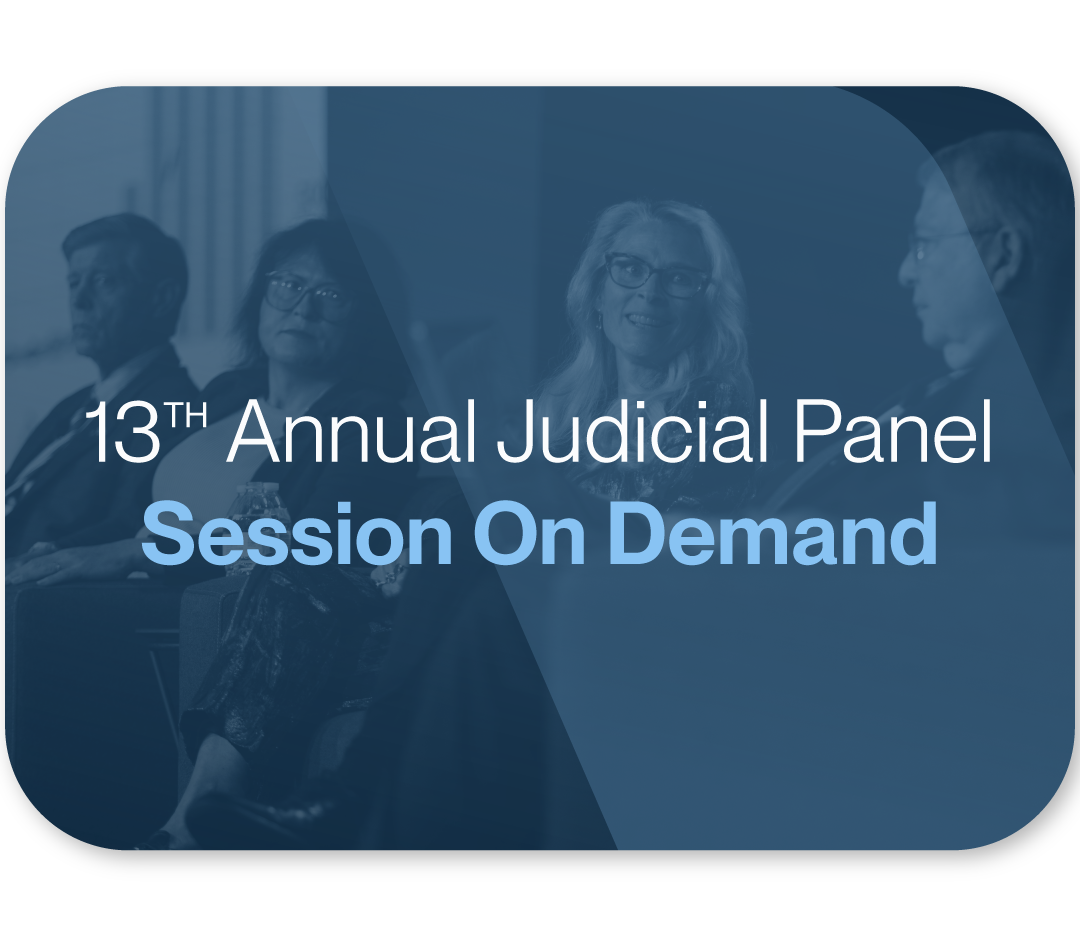
The 13th Annual Judicial Panel, ever a RelFest highlight, brought together five judges with a combined 85-plus years of judicial experience across federal, state, and UK courts. Suffice it to say, they’ve seen it all. Meet the panelists:
- U.S. Magistrate Judge Allison Goddard, U.S. District Court for the Southern District of California
- U.S. Magistrate Judge William Matthewman, U.S. District Court for the Southern District of Florida
- Dr. Victoria McCloud, Judge, England and Wales (Ret.)
- Hon. Michelle Rick, Michigan Court of Appeals
- U.S. District Judge Xavier Rodriguez, U.S. District Court for the Western District of Texas
Relativity’s David Horrigan led the conversation, and he didn’t hold back on the topics on everyone’s mind. First up: hallucinations.
Hallucinations: How Far Does Candor Go?
David opened with a number. In October 2025, Damien Charlotin’s tracker had just passed 400 hallucination cases. A year later that count stands at 2,262 – and it’s still climbing.
David’s question for the panel was, if we can’t eliminate hallucinations, how far can candor and contrition go? The judges agreed that a little goes a long way.
Own it, fast. For Judge Matthewman, it comes down to owning your mistakes. He outlined what a good response looks like:
- Fess up
- Call the other side proactively
- Pay any fees
- Withdraw the documents
- Move forward
Honesty can spare you serious sanctions. Shifting blame, using more AI to cover your tracks, or showing no remorse for the harm to the other side only makes things worse. Better yet, skip the whole ordeal by triple-checking everything you file.
At the 2025 Judicial Panel, Judge Rodriguez conceded that AI hallucinations were an issue, but he questioned the significance of the number of hallucination cases. Judge Goddard continued that theme in this year’s Judicial Panel.
A frequency illusion. Judge Goddard sees the hallucination count as a numerator without a denominator.
“If you knew there were 10 fatal plane crashes, would that tell you anything about plane safety?” she asked. She called it a frequency illusion – one that’s rippled across the country, leaving judges afraid to use AI and lawyers banning it. Goddard doesn’t think that helps.
When she teaches, she tells students who are worried about hallucinations to read the cases and run them through AI tools, too. “It’s unnecessarily scary and I’m not quite sure it’s productive anymore.”
Will the number ever shrink? Maybe, said Judge Rodriguez, for two reasons:
- The models are getting better – a lot better – and that progress deserves acknowledgement
- Some in the legal community are overreacting
Extra caution is good, but banning AI (to the extent anyone can ban it in practice) just means people use it at home. Judge Rodriguez cast his vote for less antagonism.
The view from the appellate bench. Judge Rick hasn’t felt the full wave yet. “The tsunami has not yet reached us,” she said. She’s seen more self-represented litigants, and the hallucinations she’s encountered came from attorneys still learning proper prompts and proper use.
In one case, an attorney ran their factual content through AI without checking it, and the AI changed material facts. For Rick, the real uptick is in motion practice: “We are slammed,” she said, with what feels like more motions – often from pro se litigants – than ever.
The view from across the pond. Dr. McCloud sees the same problem. The US may be the “litigation fiesta of the world,” but hallucinations still turn up in Ireland and the UK. Models are getting better at catching them, but they happen anyway.
Her advice: treat it like any professional obligation. Don’t double down – own it. What happens to the data next year will be the most telling, she said, and this is just the beginning.
Judges and Their Use of AI
Many judges are still on the sidelines, and the panel had thoughts on why. A 2026 survey of 500 federal judges, led by a handful of legal professionals, including Judge Rodriguez, put numbers to it: 38.4 percent of respondents said they never use AI, while 5.4 percent use it daily. The rest fall somewhere in between.
Judge Goddard wasn’t surprised by the number of nonusers. “They don’t really have to use it,” she explained. With clerks and support staff to help, she said, “our resources are not as scarce.”
Judge Matthewman wasn’t surprised either, but he wonders how many judges know when they’re using AI.
The dangers are real, and many self-represented parties have fallen prey, but so are the benefits. AI will never take away a judge’s decision-making, he said, but it can make judges more efficient so they can dispense justice better.
Judge Rodriguez found that the surprising part was that so many judges use AI monthly, weekly, or even daily.
State courts tell a similar story. A later survey of state judges, by David, Judge Rick, and others, showed comparable results. Judge Rick had a message for state judges who say they aren’t using AI: “Yeah, you are.” Plenty of people use it every day without realizing it. “At the risk of being thrown off the stage, I think it comes down to resources,” she said. “I didn’t have anybody. I was my research clerk. That’s where AI comes in.”
The UK and Ireland. Across the Atlantic, Dr. McCloud described a different picture. The UK takes a laissez-faire approach, with a “be careful” caveat. Ireland is more prescriptive, and judges there are discouraged from using AI.
Train, Train, Train
Whether judges use AI or not, the panel agreed: everyone needs training, and courts need clear policies.
Accuracy comes first. Judge Matthewman cannot stress this importance enough. He meets with his clerks daily and trains them himself to make sure their work is accurate.
He is a big believer in AI, even using it to craft a speech and ceremony for the wedding of one of his law clerks. “It was a real hit in the courthouse,” he said. “I had people asking me to email them my script.”
It’s a great aid, but it isn’t perfect. His broader point: “We just have to give guidance. Just like law firms have to have guidance, so do the courts.” Courts, which are notoriously slow moving, need clear policies.
Training has been slow to arrive. Judge Rodriguez said that he expected more support by now. There’s no vetted tool list, and judges are largely figuring this out on their own.
In his view, courts need formal training beyond policy – the “how to,” with real use cases and a guide. He can’t endorse products, but he can suggest workflows, along with a healthy dose of caution. It’s a work in progress.
Proportionality in the Era of AI
Next, David asked the panel about proportionality under Federal Rule of Civil Procedure 26(b)(1).
Build on it. Judge Matthewman is a believer in using technology-assisted review (TAR) and in any technology that helps parties produce relevant material quickly. “Our legal cases take far too long. Justice delayed is justice denied,” he said. “The lawyers, parties, and judges have the tools necessary to move the case forward very, very quickly. There’s something about finality.”
It’s a progression. Judge Goddard agreed. The rules themselves aren’t going to change, she noted, so the work is in how we apply them.
Think of AI as a harness. In the UK, TAR is always encouraged, and civil litigation favors targeted discovery. Dr. McCloud suggested starting with something like keyword searching so AI doesn’t run away from you. In other words: don’t just throw everything at AI first.
Privilege and Work Product in the Era of AI
Courts haven’t settled whether AI conversations are protected, and three recent decisions show that split:
- United States v. Heppner: No protection
- Warner v. Gilbarco, Inc: Protection granted
- Morgan v. V2X, Inc: Protection granted
David asked the panel the obvious follow-up: What are you going to do about work product in the era of AI?
Michigan has a persuasive voice. Judge Rick said the Michigan Court of Appeals doesn’t have a specific vision yet. Judge Patti, who decided Warner, sits in the U.S. District Court for the Eastern District of Michigan, so his reasoning carries weight with courts across the state.
Don’t treat AI use as a waiver. Judge Goddard was blunt about her aversion to the idea that a party should have read the terms of service and expected anything entered into an AI tool to be anything but private. In her view, that logic would mean that by using the tool, you would knowingly give up everything you put into it. “I’m really bothered,” she said. “I don’t like that.”
She referenced the Heppner decision: “Does that mean that anyone with a Gmail account has forfeited all rights to confidentiality and privacy?”
Prompts are protected thinking. Judge Matthewman doesn’t see the debate as close. To him, prompts are clearly work product, and he believes there could be situations where they could be covered by attorney-client privilege as well.
Prompts aren’t search terms. Judge Rodriguez drew a line between the two. Search terms are factual matters, but prompts aren’t. He offered a comparison from the old days: A junior partner would gather 20 associates, hand them the case and the complaint, and set them to work. Nobody doubted that the resulting memo was protected work product, and he sees prompts the same way.
The Judicial Outlook on AI
David closed by asking each judge to sum up their outlook on AI: optimistic, concerned, or neutral?
The consensus is a brighter view ahead. The answers ranged from cautiously optimistic to highly optimistic, but every judge landed in the same place. AI is proving to be less expensive, more efficient, and faster. Dr. McCloud even thinks we may be over the hump on hallucinations.
Channel the concern into action. The panel said that while concern is valid, it should propel us forward, not hold us back. The stakes, as Judge Rick reminded the room, are the 50 million people waiting for the courthouse doors to open. So what are you waiting for? Use the tech.
Judge Rodriguez had the last word: “Across all case types there’s more data than ever before. I don’t see that declining. AI is the only way to navigate all of this. We have to be optimistic.”
Graphics for this article were created by Sarah Vachlon.
Recommended for you