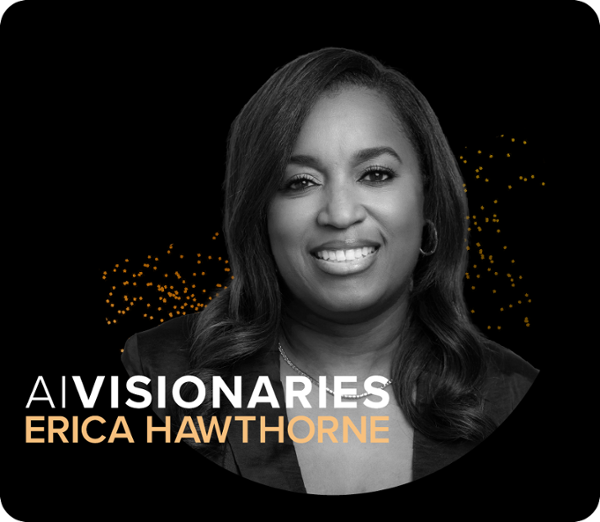
Erica Hawthorne, a senior manager of e-discovery at Salesforce, has always had a passion for the law. Visions of a career in this space danced in her head for a long time—and early on, she’d assumed that meant she’d become a lawyer.
But before going to law school, hoping to balance a new career with the joys and demands of family life, she started working as a corporate paralegal. Erica found herself delighted by the unique challenges and professional opportunities that stretched out in front of her on that path, and tells us that she was quickly captivated by the structure and strategy of the legal world. But it didn’t take long before she saw opportunities to help it all run smarter.
“I saw an opportunity for greater efficiencies and innovation in the legal process,” Erica recalls. “Innovating and expressing ideas to make work more efficient has always interested me. The evolving technology in e-discovery provided a solution to these challenges.”
That realization became an inflection point. As it turned out, the intersection of law and technology is a pretty fascinating place to be—and Erica was in it for the long haul. She jumped at every opportunity to see how data could be leveraged to make workflows not just faster, but more insightful. Over the last 15 years, that passion has guided her journey to becoming a 2025 AI Visionary: a leader who doesn’t just adapt to change, but helps define it.
“I thrive on the opportunity to bridge the gap between legal expertise and technological advancements,” she says. Her goal? “Ensuring that legal teams can focus on strategy while technology handles the heavy lifting.”
Finding the Nuance Deep in Your Data, Faster
Modern data is as complicated as the people who create it—and we create lots of it. In fact, there is so much of it, featuring so much complexity, that simple search just doesn’t cut it anymore for e-discovery.
“With a search term, you can’t pick up the nuances of a document. You can’t pick up the communication style or what a person really meant in a document,” Erica says. “But not only that, with short messages, you also now have emojis and all these other things search terms can’t capture at all.”
Fortunately, she says, while searching will always be part of e-discovery, “generative AI can capture those nuances better. It can understand the emojis in context,” she continues.
“One day we’re going to look back and think, ‘we really spent hours trying to find the right search terms for these documents?!’” she predicts.
And speaking of “we”—Erica talks about her team at Salesforce warmly and with great camaraderie.
Her colleague, Leo Murgel, is senior vice president and COO of legal and corporate affairs at Salesforce. Leo was named an AI Visionary in 2024; Erica says he “inspires [their] team to embrace innovation and tackle complex challenges with creativity and purpose.”
Leo joined Erica and Relativity for a recent conversation celebrating her AI Visionary recognition and, for his part, he agrees that the advent of generative AI has absolutely changed the future course of e-discovery work.
“As technology evolves, it often becomes simpler,” he says, comparing the DOS commands of early computing to the simplicity of using a laptop today. “Search is one example of that. I think we’re going to start having conversations with data at scale, as opposed to this limited application of search terms in one context or another.”
The Human Element Remains Essential
Despite the power of AI, Erica is confident that the heart of legal work will always require human insight.
“I believe AI will not completely replace human roles in the legal industry,” she says. “Human reasoning and judgment are essential for legal strategy, nuanced tasks, and contextual understanding. Ethical oversight and validation will always need people. Ultimately, a combination of AI and human expertise will be the most effective approach.”
And, for both Erica and Leo, the human collaboration that goes into the best AI strategies (as well as legal ones) is where the magic happens.
Fanning the Flames of Innovation in Legal Tech
Getting to that interrogative, free-flowing future of data analysis can only happen one step at a time, but we’re certainly on our way. And for Erica? It’s an exciting journey.
“I’m a curious person by nature,” Erica says. “A lot of times, I have that ‘I wonder…’ sense—and it keeps me up at night, but pulling that thread of ‘I wonder’ and seeing where it takes you? That often leads to an innovative thought and a problem solved.”
She’s equally energized by the broader implications of AI.
“I’m excited about AI’s potential to drive innovation and efficiency across organizations,” she says. “The ability to automate repetitive tasks and streamline processes allows us to focus on higher-value work. It’s transformative.”
To get there, professionals—including non-technical legal practitioners—need to jump in with both feet. The good news is that their role in this new AI era will simply be to keep doing what they do best.
For example: “Non-technical practitioners of AI can hold software and service providers accountable for responsive AI development by asking informed and critical questions that address ethical, functional, and operational aspects of the technology,” Erica emphasizes.
Such questions should include:
- How do you test for and mitigate bias in your AI models?
- Does your AI comply with industry and privacy standards?
- How does the system handle false positives or negatives, and what tools are available for maintaining human oversight?
- What safeguards are in place to prevent the misuse of the AI system’s capabilities?
The more we have these conversations and get some hands-on practice with AI, in both personal and professional contexts, the more prepared we’ll be to leverage new tech in the best, most responsible ways.
For anyone looking to take a first step into this future, her suggestion is simple but profound: “Start small. Explore basic AI tools or take a free online course. Just understanding what AI is—and how it’s already part of everyday life—is the best way to move forward.”
Graphics for this article were created by Sarah Vachlon.

Recommended for you