


Asked. Answered. Discoverable. That’s the arc of a new kind of legal evidence: the questions people are feeding to AI tools at work, the answers those tools give back, and what shows up later when someone goes looking for them in court.
Half of employed American adults now use AI in their role, according to a recent Gallup survey. Each one of those interactions is a record. Not of what someone did, but of how they got there: the back-and-forth, the second-guessing, the moments where an answer started to take shape.
It’s a new class of legal evidence, and it’s already reshaping disputes before most of the industry has even settled on a name for it.
A New Class of Legal Evidence
Email captures the conclusion. AI conversations capture how the person got there.
These records don’t look like anything else in discovery. A single conversation might mix typed prompts, uploaded images, code, generated artifacts, and the AI’s own metadata about what the conversation was about. The signal-to-noise ratio is inverted from email: most of what’s interesting is buried in the back-and-forth, not summarized at the top of a message.
Two recent matters show what’s at stake.
In In re: OpenAI, Inc. Copyright Infringement Litigation, the Southern District of New York ordered OpenAI to produce a sample of 20 million de-identified ChatGPT conversation logs as discovery evidence in the New York Times-led multidistrict litigation. In affirming the magistrate judge’s discovery order, the district court judge rejected OpenAI’s privacy-based objections. AI conversations are now discoverable.
In a Delaware Court of Chancery ruling earlier this year, Vice Chancellor Lori Will found that the CEO of Krafton had consulted ChatGPT to plan a corporate “takeover” aimed at dodging a $250 million earnout payment to the developers of Subnautica 2. He admitted under oath that he’d used ChatGPT, and that he had deleted specific conversations. The deleted chats became key evidence of the CEO’s intent, and the court ordered the studio’s leadership reinstated. Not only do AI conversations reveal intent, but deleting them can as well.
Disputes aren’t just about what someone wrote in an email anymore. The AI conversation matters too: what got asked, what came back, and what happened next.
Building for the Moment Before It Arrived
In 2024, before federal and state rule-makers had begun drafting evidence rules for AI-generated material, and before "Compliance API" became the standard pattern enterprise LLMs would adopt, Relativity built the platform capability to handle this new class of evidence. It's been in production with customers ever since and has a patent pending. As each major enterprise frontier AI platform has come online (e.g., ChatGPT Enterprise, Gemini for Google Workspace, Microsoft Copilot, and now Claude Enterprise), RelativityOne has been ready to collect it.
Raw conversation logs become structured files that preserve the back-and-forth. Each message inside gets tagged for responsiveness, relevance, and privilege, with metadata at both the conversation level and the individual-message level. And when it's time to produce, the system handles redaction that protects the context around a privileged message, not just the message itself. We designed and built RelativityOne for the type of evidence we predicted was coming.
What Just Shipped and What It Means
A two-year head start shows up in the platform.
Collect in RelativityOne now spans the two categories of enterprise AI surfaces where work actually happens. Foundation-model platforms like ChatGPT Enterprise and Claude Enterprise are where deliberate AI work originates: drafts, research, strategy, code. Meanwhile, embedded productivity assistants like Microsoft Copilot (collected through Microsoft Purview) and Gemini for Google Workspace are where AI is built into everyday tools, like drafting emails or summarizing a long document.
With the news we announced May 21, Claude Enterprise joins ChatGPT Enterprise and Gemini Enterprise as native sources. That makes RelativityOne the leading legal data platform with native collection across all three major enterprise LLMs.
And this isn’t theoretical. Enterprise legal teams at leading organizations are already using Collect to bring ChatGPT and Gemini data into their matters today. This month’s launch extends that footprint to Claude Enterprise.
Once collected, the conversations land in RelativityOne already structured in our RSMF format for human and AI review. From there, Relativity aiR, our purpose-built legal AI, takes over the substantive analysis. aiR can review documents for responsiveness, flag privilege, and surface case strategy, all grounded in the evidence itself, with rationales and citations users can audit. It’s the same agentic capability we’ve written about before, now working on a new evidence class.
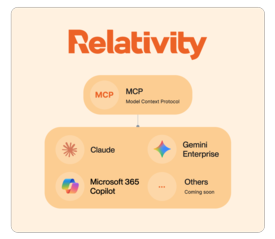
Our separate Model Context Protocol (MCP) integration, unveiled with Anthropic’s launch of Claude for the legal industry, adds a natural-language orchestration layer on top of all of this. Our customers can now use Claude to stand up matters, configure workspaces, and manage workflows in RelativityOne by conversation. The substantive legal AI work still happens in aiR, and the data still lives in RelativityOne.
The Only Legal Data Intelligence Platform on the List
This month, Anthropic launched 28 Compliance API integration partners across DLP, SASE, identity, SIEM, AI security posture management, and more. Relativity is the only AI platform for legal data intelligence in that group.
That isn’t a coincidence. The other 27 categories (DLP, identity, AI security posture, telemetry) are governance tools that help monitor AI use, restrict it, or flag security risks. e-Discovery and legal data intelligence are different. It’s the discipline that turns that usage into legally defensible evidence when a matter ends up in court. RelativityOne is the leading platform purpose-built for that work at the scale legal data demands.
That’s what we mean when we say RelativityOne is where this new class of data gets governed, analyzed, and acted on. One platform, end to end.
Where This Goes Next
AI conversations aren’t a hypothetical class of evidence anymore. They’re discoverable, they’re showing up in disputes that matter, and the volume is only growing.
The evidence didn’t exist yet when we started building. It does now. And we’ll have more to share at Relativity Fest London in June.
Graphics for this article were created by Kael Rose.