

For 25 years, this community has been focused on a simple idea: organize data, discover the truth, and act on it. That is the work.
And this week at RelFest London, we showed what that work has become: 31 countries, 242,000 users, 370,000 workspaces, and 93 petabytes of legal data, growing every day. That is Legal Data Intelligence at a global scale, and some of the most complex and forward-leaning of that work is happening right here in the UK, across Europe, and throughout EMEA.
On stage, I shared the equation that runs underneath all of it: data, multiplied by AI, equals high-value results. Last year, Relativity aiR executed more than 180 million high-value legal results across customer matters. This year, we have already passed 375 million. These decisions are not on experiments or pilots, but on real work, real matters, in one defensible system. At one of the world's largest corporations, an internal investigation that used to take 60 days and a full team now takes one investigator 45 minutes.
That momentum comes from the platform: our foundation, where your data is processed, structured, and enriched with meaning; the engine layer, where agents, skills, and tools turn data into action with the right governance and the right autonomy for legal work; and the experiences, where all of it shows up for you, across every surface where your teams work.
That last layer is where the story is moving fastest. Here is everything we announced in London.
aiR Assist is Now Generally Available
Early case intelligence shapes the trajectory of legal work, but getting to it quickly has been a persistent, industry-wide challenge. aiR Assist closes that gap. Legal teams can now ask plain-language questions of their data the moment it enters RelativityOne and get back precise, citation-backed answers that connect documents, evidence, and relationships across the full data landscape of a matter.
Because aiR Assist operates directly on data already governed within RelativityOne, every answer stays grounded in a complete system of record: traceable, explainable, and defensible. And because it will be included in the standard RelativityOne offering starting June 23, you can use it across your existing work at real-world scale, with support for up to 300,000 documents per index and 1.5 million documents per workspace.
The proof is already in. When Interpath, an international advisory firm, was appointed to support a complex multi-jurisdictional fraud investigation and asset seizure, the team needed to rapidly identify critical evidence from more than 30,000 largely unstructured documents under active investigative deadlines. Using aiR Assist, investigators immediately began exploring the data by asking plain-language questions and following investigative threads. The approach uncovered an email from several years earlier that directly impacted their case.
And this is just the start. aiR Assist will power interactive memo drafting, coming soon in aiR for Case Strategy, so users can request any work product they want, like case summaries or issues analyses, based on the facts and documents analyzed. Looking ahead, aiR for Case Strategy will also be part of the standard RelativityOne offering beginning July 1.
From there, we are building toward aiR Assist not just answering questions but acting on them, to be able to use natural language to trigger context-aware workflows that keep matters moving.
Custom Analyses in aiR for Review: Define Your Own Review
aiR for Review already comes with a powerful set of purpose-built analyses designed to cover a range of critical review workflows, helping legal teams identify and classify key content across millions of documents with outputs they can verify and defend. But no fixed set of analyses can anticipate every case type, every regulatory context, or every client’s unique requirements.
Custom analyses are the complement: legal teams can now define their own document review analyses using natural language prompts, without writing code or engaging any engineering resources.
Every matter is different, and the use cases from our Advanced Access program tell that story well: medical record classification in healthcare litigation, sensitive workplace communication review, and construction defect identification. Custom analyses also extend to visual content, extracting text, recognizing objects and brands, and surfacing insights from photos, diagrams, and drawings. The ability to define precisely the right analytical lens for a specific matter, test it on a subset of documents before full deployment, and iterate until you are confident in the results makes for a meaningful capability shift: the review shaped to the matter, not the matter forced into the review.
AI Visionary Andrew Milauskas, chief operating officer of Page One, participated in the Advanced Access program for this capability and explained it well: “What makes custom analyses powerful is its flexibility. The information that matters in a medical records review looks nothing like what we’re after in a communications case or a construction defect investigation. Instead of forcing everything into the same process, we can start getting meaningful results almost immediately.”
And we are not stopping there. Up next is cross-matter and cross-instance deployment, so what you build and refine for one matter becomes a reusable asset for future matters – turning institutional knowledge into standardized, scalable workflows. Custom analyses will be generally available in RelativityOne on June 30.
Many Surfaces, One Platform
We built the platform from the ground up: foundation, engine, experience. But that is not how you meet it. You meet it on a surface, and two of those surfaces took a big step forward in London.
Microsoft Word, through Gavel. Lawyers don't live in one platform alone. The intelligence has lived in RelativityOne, but the work product it shapes – the motions, briefs, and contracts – has had to leave the platform to get written. So, we did something about it: we have acquired Gavel, with plans to bring AI-native drafting directly into Microsoft Word. What aiR generates could open directly in Word, where lawyers could draft, redline, and finalize right where they already work, with every edit syncing back to the matter in RelativityOne. Rather than pulling lawyers out of Word, Relativity could extend the system of action into it. We are working to make the first version of this integration available in Advanced Access later this year, with plans to show more at RelFest Chicago.
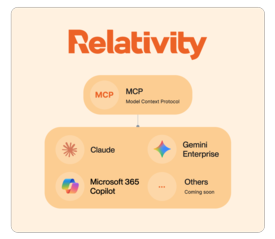
Claude, through our Relativity Model Context Protocol (MCP) connector. RelativityOne administrators can now use Claude to stand up a matter, shape a workspace, and manage access just by asking, in plain language. The architecture here is important, so let me be precise about it. You orchestrate from Claude, the conversational surface. RelativityOne is your system of record and system of action – where the work happens and your data lives and stays governed. And aiR delivers the analysis, on your evidence, under your controls. Your data never leaves the platform, and every action is audited. Asking isn't analyzing. That is the line, and it is what defensible by design looks like in an agentic world.
One More Thing
At the center of every matter is the lawyer: the judgment, the strategy, the call that has to be made. This morning in London, Relativity CEO Phil Saunders set the standard that our platform has to reach more legal professionals. So, we are building one more surface for them. It has the capability to be a new Relativity experience where the conversation is the workspace: ask questions, explore evidence, and draft work product around the matter, all connected back to your team in RelativityOne.
Here is what that could mean in practice. The lawyers, GCs, and advisors who set the direction on a case or investigation could ask questions in plain language, explore the evidence behind every answer, and draft work product grounded in the facts, moving from one line of inquiry to the next without losing context or leaving the conversation. And everything created there could be connected back to the team's matters in RelativityOne – running on the same aiR engine, governed, audited, and defensible by design.
It is early, but it is real: we have begun adding customers to Advanced Access and will enroll more of you in the months ahead. What it becomes, you will shape, the way you have shaped everything we build.
Let's Go Do the Work
Here is what I asked of the room in London, and what I will ask of you: don't finish reading this the same way you started. Find the one thing – one workflow, one matter, one decision that has been sitting on someone's desk too long – and put aiR on it this week. Not next quarter or after the pilot. This week.
This, all of it, is what reimagining legal looks like – and it’s happening right now. We built this platform with you. Now let's go do the work, together.
aiR Assist is included in RelativityOne subscriptions beginning June 23, with custom analyses in aiR for Review following on June 30. To learn more, contact your account team or visit relativity.com.